Coding agents and productivity: what the METR studies actually show
A technical analysis of METR's measurements of AI-assisted software development, their limitations and the implications for credible internal evaluations.
Key finding
The studies do not provide a universal productivity number for coding agents. They show how closely outcomes depend on tool maturity, task selection and measurement design.
The situation
Productivity claims about coding agents are often treated like product specifications: a percentage that can be transferred from a benchmark to a development organization. The METR publications demonstrate why that is unsafe. Their main value lies in showing how a clean early result has to be reinterpreted when tools, usage patterns and sampling conditions change.
The useful question is therefore not whether AI accelerates software development in general. A defensible decision starts narrower: Which tasks can a defined team complete faster or better with a specific tool while maintaining explicit quality constraints?
The early randomized finding
In early 2025, METR studied experienced open-source developers working in repositories they knew well. The researchers randomly assigned 246 real tasks to work with or without the available AI tools. In that setting, developers using AI took 19 percent longer on average. Before the work, they expected a speed-up. After completing it, they still believed they had been faster than the measurements indicated.
The result matters, but its boundary matters equally. It concerns experienced maintainers, familiar codebases, a particular task mix and early-generation tools. It proves neither that coding agents are generally harmful nor that subjective experience has no value. It demonstrates that perceived ease and measured elapsed time can diverge.
For organizations, the immediate lesson is that adoption data is not performance data. A tool may feel helpful, produce more code and still create additional verification, correction or coordination work.
Why later evidence became harder to read
METR continued the work with newer tools. Its later update explicitly describes selection problems. Participants had more discretion over when to use AI. People who already operate a tool effectively, or expect it to help, are more likely to select it. Parallel agents also complicate time attribution: a developer may wait, review output, start a second task or coordinate several runs.
In its May 2026 Frontier Model Risk Report, METR reports a small positive productivity effect, approximately four to twenty percent, for public agents from late 2025. The report also explains why that interval may underestimate some effects and why self-reported gains are much larger but more uncertain.
These findings are not necessarily contradictory. They describe different tool generations and different measurement conditions. Any account that repeats only the 19 percent slowdown, or only a later speed-up, removes the information needed to interpret the number.
What counts as productivity
Completion time is useful, but incomplete. Software delivery requires at least three levels of measurement:
- Task level: active time, waiting time, iterations and the share of tasks completed successfully.
- Quality level: defects, review effort, test coverage, security findings, maintainability and later rework.
- System level: deployment frequency, change failure rate, recovery time, flow and the load moved to other roles.
A local speed-up can reduce system performance. More pull requests do not help when review becomes the constraint. Short implementation time is not a gain if subtle defects appear in production. Conversely, an agent may be useful without shortening a single task when it improves tests, documentation or the range of alternatives considered.
OpenAI’s audit of SWE-Bench Pro illustrates a related measurement failure. The published review classified roughly 30 percent of the examined tasks as broken or not reliably gradable, citing issues such as inadequate tests, underspecified requirements and misleading prompts. A precisely calculated score is still unhelpful when the instrument does not represent the decision an organization needs to make.
A credible internal evaluation
Organizations should not look for a universal agent multiplier. They should establish a repeatable local measurement.
Define task classes first
Useful candidates are recurring and sufficiently comparable: small fixes, test additions, migrations, documentation or tightly scoped features. Exploratory architecture work should be treated separately. Classification must precede measurement so that successful examples are not selected afterwards.
Establish a baseline and quality constraints
Historical or controlled comparison data is needed before adoption. Acceptance criteria, tests, security checks and review rules stay constant. A failed quality gate cannot be offset by shorter completion time.
Count the entire active workload
Working time includes prompting, context preparation, waiting, inspection, correction and abandoned attempts. With parallel agents, teams should also record calendar time until a usable change is ready. The two measures answer different questions.
Decide on outcomes and side effects together
Adoption is justified when the intended effect remains stable across several task classes, quality constraints hold and review or operations do not absorb an unacceptable burden. The answer may be selective: use for tests and migrations, but not for security-critical core logic.
Conclusion
The METR series is not a verdict for or against coding agents. Its methodological lesson is more durable: productivity is contextual, perception can be wrong, and even a rigorous result ages as tools and usage change. That does not justify waiting. It supports a more precise course of action: start narrowly, define measurements in advance, treat quality as a hard constraint and revisit the evidence regularly.
Original diagrams
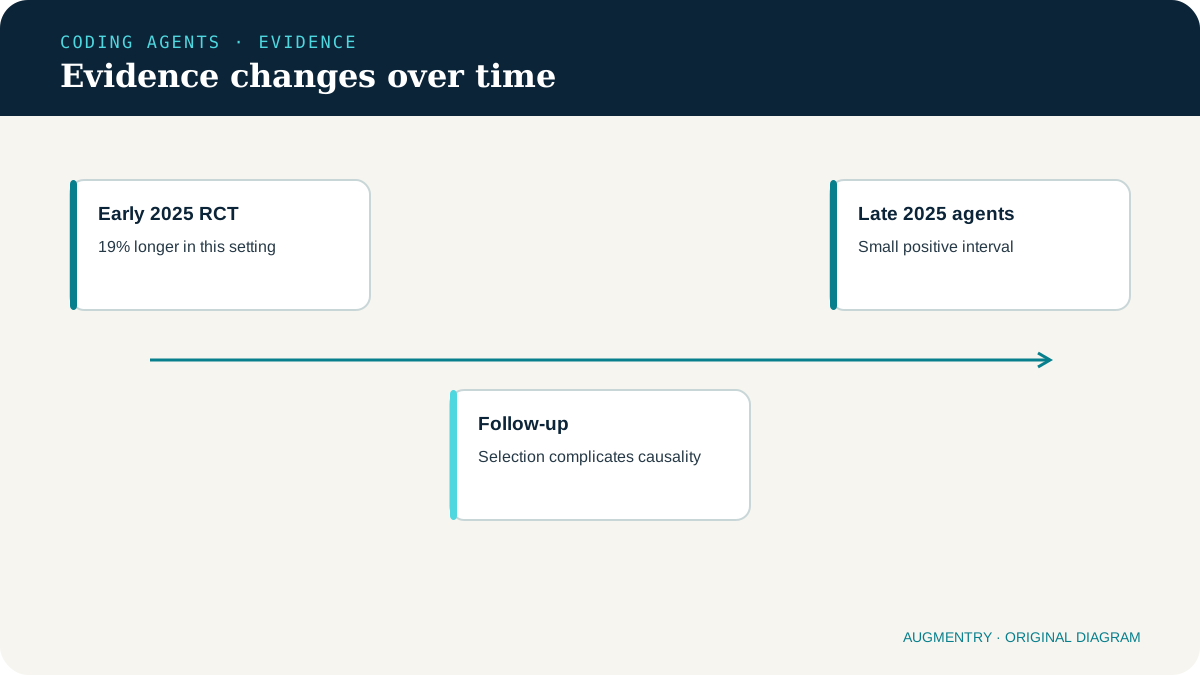
Coding agents · Evidence
Evidence changes over time.
-
Early 2025 RCT
19% longer completion time in this setting
-
Follow-up
Participant selection complicates causal interpretation
-
Late 2025 agents
Small positive interval
Connections in the diagram
- Early 2025 RCT leads to Follow-up
- Follow-up leads to Late 2025 agents
Different tools and study designs do not establish a universal productivity figure.
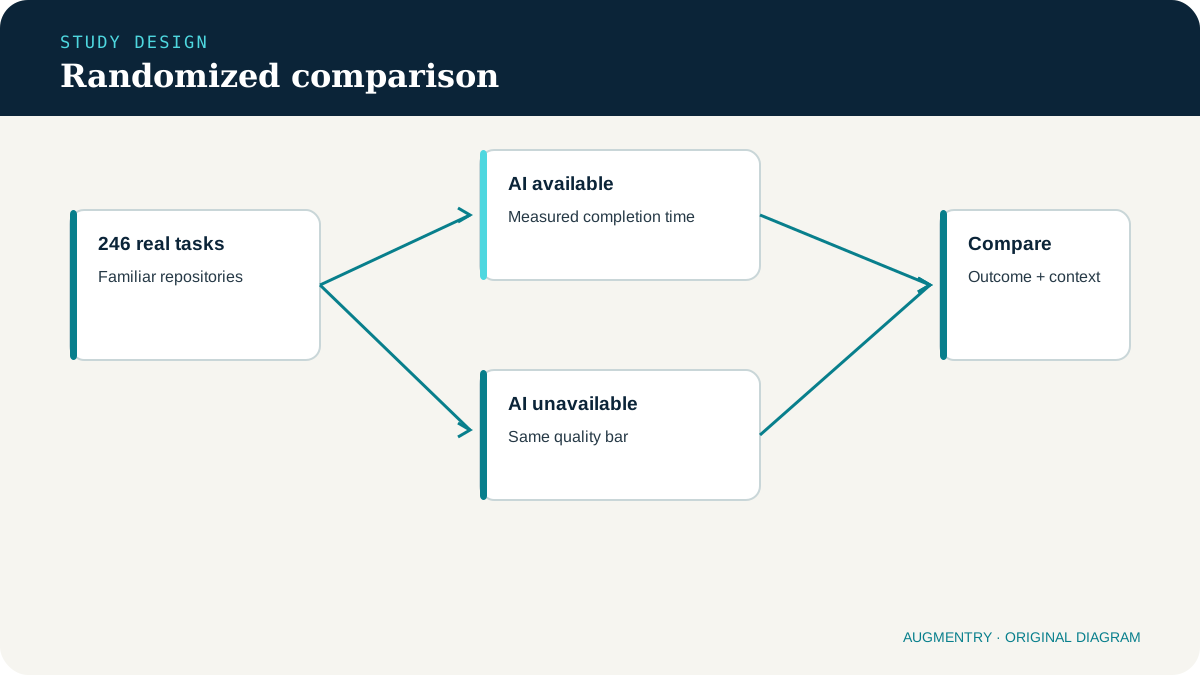
Study design
Compare randomized conditions.
-
246 real tasks
Familiar repositories
-
AI available
Measure completion time
-
AI unavailable
Same quality bar
-
Comparison
Evaluate outcome and context together
Connections in the diagram
- 246 real tasks leads to AI available
- 246 real tasks leads to AI unavailable
- AI available leads to Comparison
- AI unavailable leads to Comparison
Coding agents · Productivity
Measure the whole job.
- Implement
- Review
- Operate
Rework feeds back
All three dimensions apply across the entire workflow.
- Time
- Active work, waiting and iterations
- Quality
- Defects, tests, review and maintainability
- System
- Flow, failures, recovery and team workload
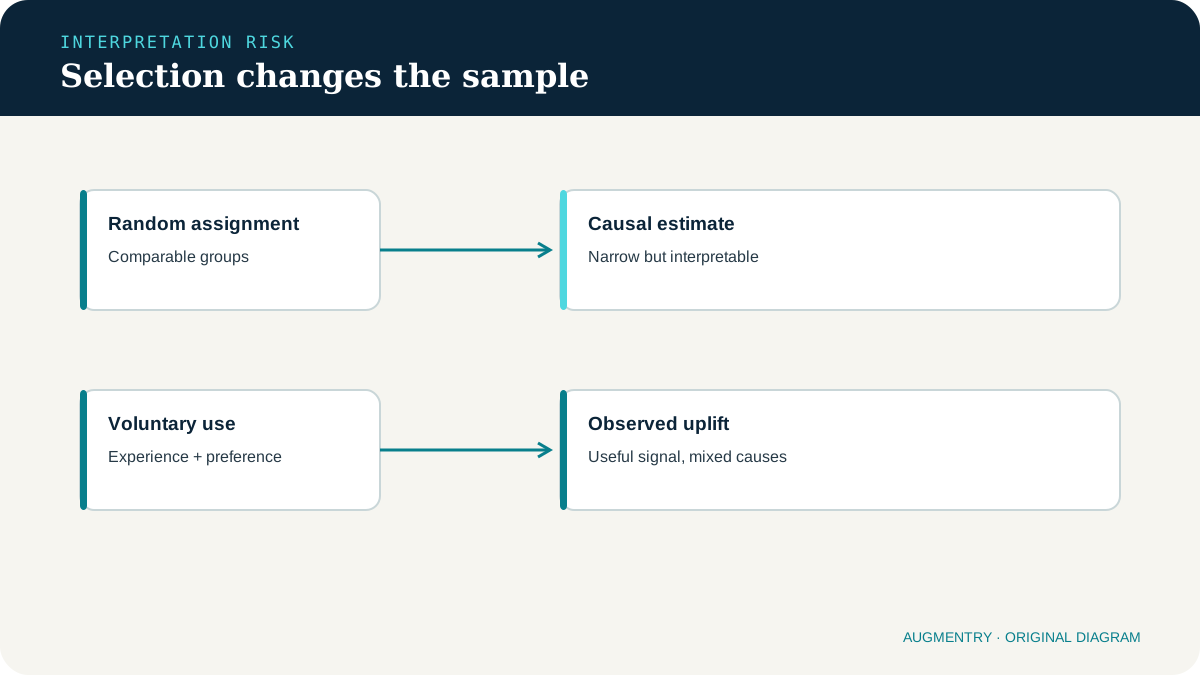
Interpretation risk
Selection changes the sample.
-
Random assignment
Comparable groups
-
Causal estimate
Narrow but interpretable
-
Voluntary use
Experience and preference
-
Observed uplift
Useful signal with mixed causes
Connections in the diagram
- Random assignment leads to Causal estimate
- Voluntary use leads to Observed uplift
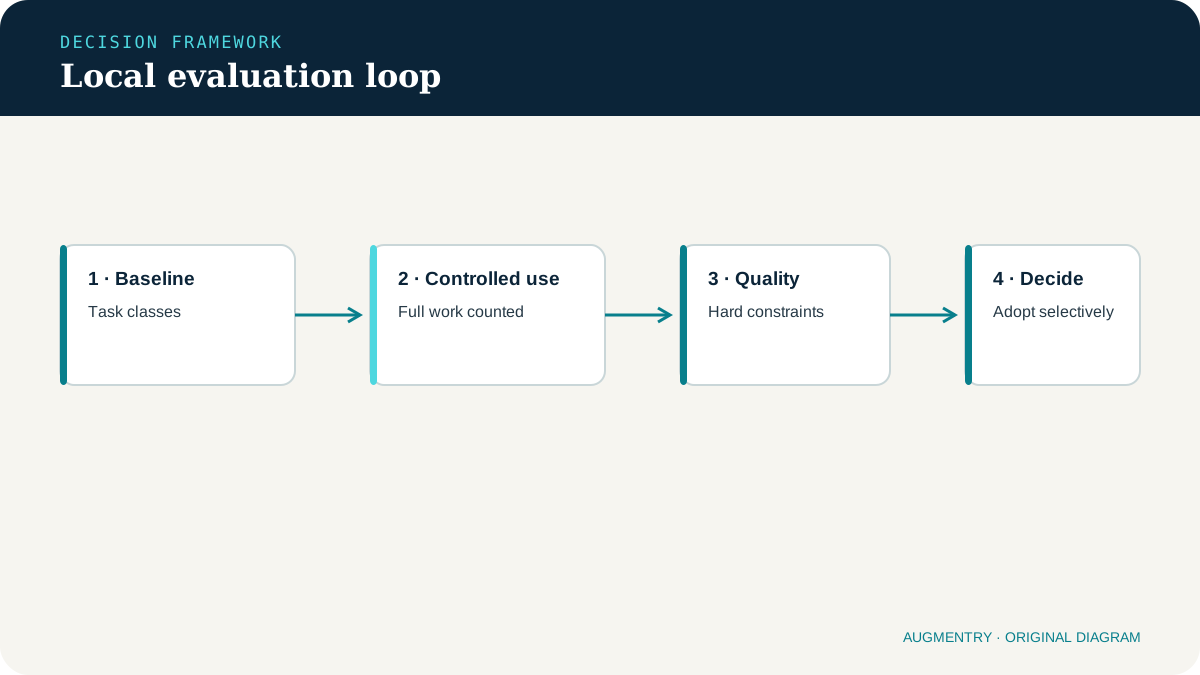
Decision framework
Evaluate in your own context.
-
Baseline
Task classes and starting conditions
-
Controlled use
Count the full workload
-
Review quality
Hard constraints
-
Decide
Adopt in suitable areas
Connections in the diagram
- Baseline leads to Controlled use
- Controlled use leads to Review quality
- Review quality leads to Decide
- Decide leads to Baseline
Limitations of this analysis
- The early randomized study covers 16 experienced developers and 246 tasks in familiar open-source repositories. Its result cannot be transferred directly to other teams.
- Tools, models and agent workflows change faster than conventional study cycles. METR now explicitly labels the early finding as outdated.
- Later observations are harder to interpret causally because of self-selection, parallel agent use and changed compensation.
Sources
-
Primary source
Early-2025 AI experienced open-source developer productivity studyMETR , 2025-07-10
-
Primary source
Measuring AI Ability to Complete Long TasksMETR , 2026-02-24
-
Primary source
Frontier Model Risk ReportMETR , 2026-05-19
-
Context
Separating signal from noise in coding evaluationsOpenAI , 2026-07-08
-
Context
Measurement frameworksDORA
What would you like to assess or build?
Briefly describe the situation, your objective and the systems involved. We will respond with a technical assessment and a practical next step.